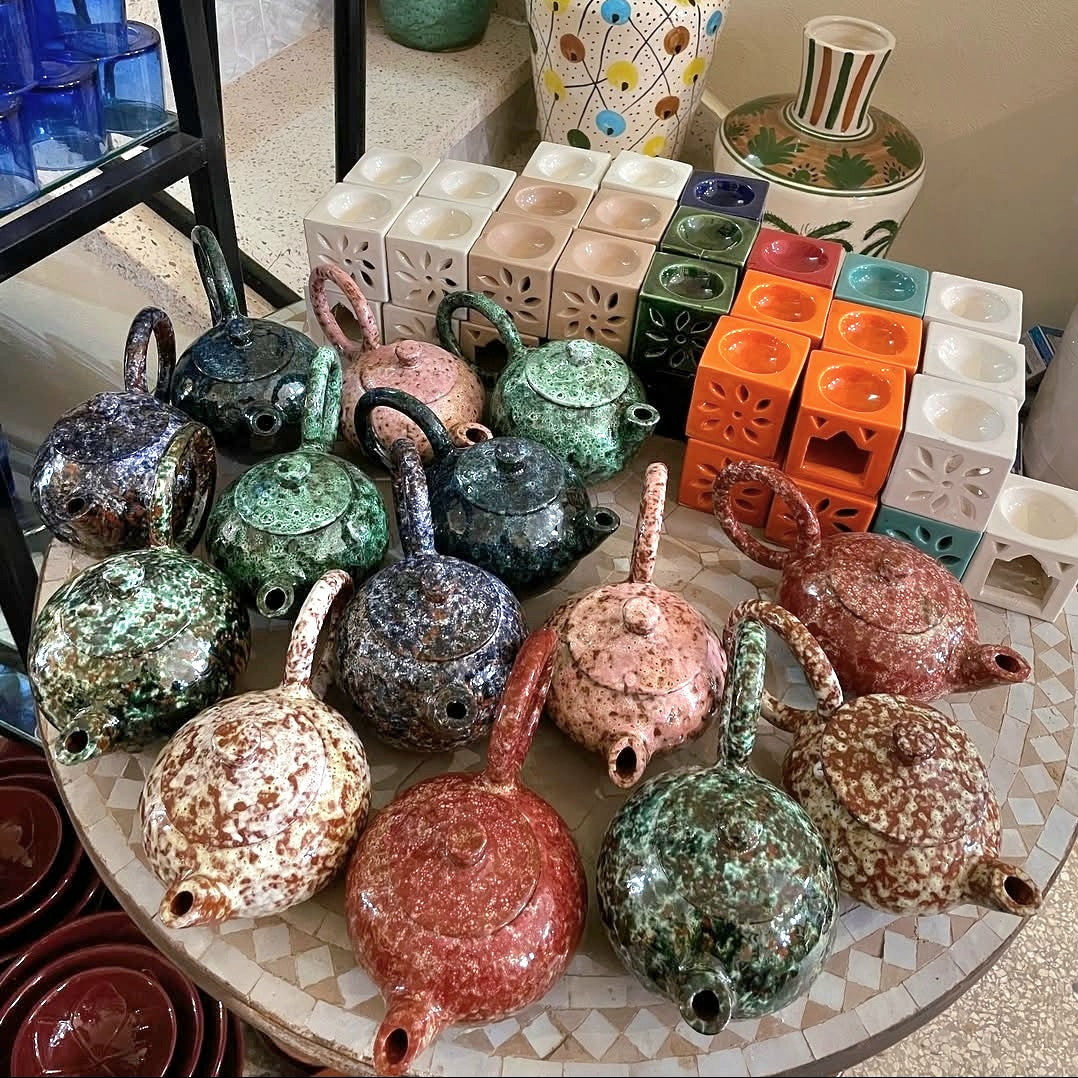
Safi, Fez, Meknes, Marrakech… Journey to the heart of Moroccan pottery
Safi, Fez, Meknes, Marrakech… A look at the iconic regions of Moroccan pottery

Behind every curve of a vase or every colorful hand-painted motif lies a story, a place, a skill passed down through generations. Far from being uniform, Moroccan pottery is an art deeply rooted in its regions. Through this article, let's explore four emblematic cities of this craft: Fez, Safi, Meknes, and Marrakech .
The geographical imprint in Moroccan pottery
In Morocco, each region has developed its own ceramic language, influenced by its history, natural resources (clay type, minerals, pigments), and local culture. These specificities give rise to distinct styles that constitute the richness and diversity of Moroccan pottery.
Fez: Andalusian refinement in the service of elegance

The cradle of Moroccan refinement, Fez is known for its decorated earthenware pieces , often adorned with geometric or floral motifs in shades of cobalt blue, emerald green, and white . This style finds its roots in Andalusian and Arab-Muslim art, with an extreme attention to detail.
The potters of Fez excel in zellige (traditional mosaics) and ornamental objects such as decorative tagines , wall plates , or large platters with symmetrical patterns . These pieces embody a sophistication that transcends centuries.
Safi: the vibrant and popular soul of Moroccan pottery

The famous glossy enamels of Safi pottery
A port city facing the Atlantic, Safi is considered the capital of Moroccan pottery . Here, the local red clay gives rise to warm and expressive creations, often covered with glossy glazes in vibrant hues: turquoise, honey, deep black…
Safi artisans are masters of the art of pottery . Their creations range from generous mugs and rustic bowls to bold decorative vases . This style is appreciated for its spontaneity, its color, and its strong connection to everyday life.
Meknes: the robustness of the high plateaus

More discreet, Meknes offers a more understated pottery, shaped by the influence of the Amazigh cultures of the interior of the country. There one finds solid, utilitarian objects: cooking pots, bowls, deep dishes, often in earthy tones ( brown, ochre, olive green ), sometimes decorated with simple geometric patterns.
This style reflects a more raw aesthetic, focused on functionality, but with a natural and timeless charm that fits perfectly into minimalist interiors.
Marrakech: the beating heart of Moroccan craftsmanship

Vibrant, lively, inspiring… Marrakech is much more than a city: it is a meeting of tradition and modernity. Its craftsmanship reflects this duality, with an incredible diversity of shapes, colors and styles .
The region's potters offer both raw pieces from the villages of the High Atlas Mountains and reimagined designs to suit contemporary interiors. The ochre clay of the region and the wood-fired kilns used in rural areas give the pottery a unique texture and warmth.
There you can find a wide variety of colored enamels, Berber or geometric patterns , as well as utilitarian or decorative pieces prized in high-end decor.
Home to numerous cooperatives, family workshops and young creators, Marrakech is today an essential hub for Moroccan crafts exported to Europe .
This ancestral know-how is expressed today in contemporary and decorative forms adapted to modern interiors.
It can also be found in everyday objects, from coffee cups to large tableware.
A wealth that transcends time.
These four cities embody the diversity of Moroccan craftsmanship . From one region to another, techniques, forms, and artistic intentions change, but the love of the craft remains. Each piece carries a part of Morocco, a blend of tradition and adaptation.

Artitrit Déco: a selection that pays homage to these roots
At Artitrit Déco , we are committed to offering you a selection of pottery that reflects this cultural diversity . Our creations are carefully chosen to highlight the richness of Moroccan traditions, while also blending harmoniously into modern interiors.
Discover our collection inspired by the most beautiful regions of Moroccan pottery .