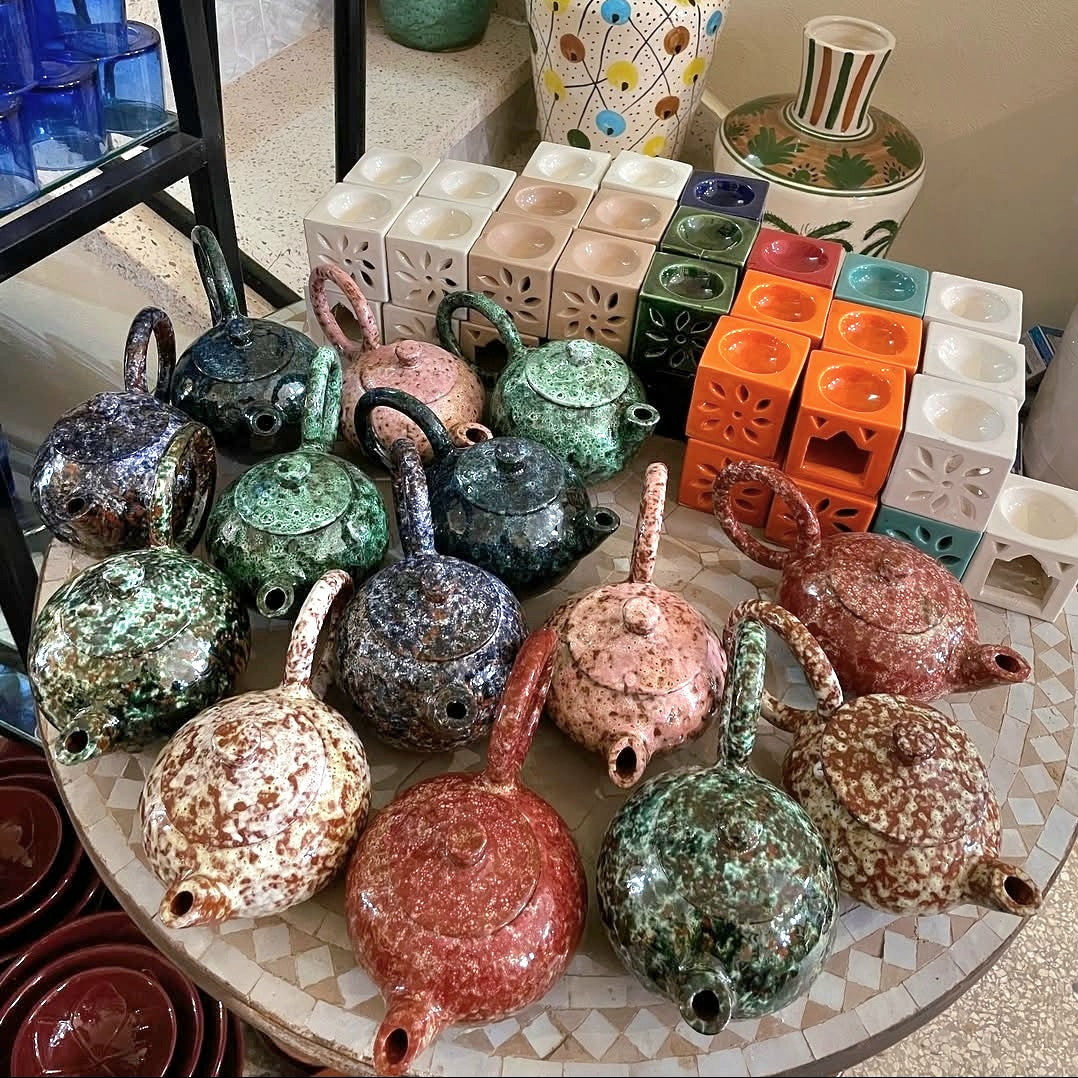
Moroccan handcrafted ceramics vs. industrial ceramics: what you're really paying for

When faced with two visually similar objects, one handcrafted in Morocco, the other industrially produced, the price difference may seem surprising. However, what you are paying for is not simply an object: it represents a choice of material, time, craftsmanship, and values.
Two radically different manufacturing methods

Industrial ceramics rely on standardized, automated processes optimized for mass production. Shapes are molded in large quantities, glazes are applied uniformly, and manufacturing times are reduced to a minimum.
In contrast, Moroccan handcrafted ceramics are shaped by hand, using techniques passed down through generations. Each piece is individually modeled, glazed, and fired, resulting in a slow production pace and constant monitoring at every stage.
Time: an invisible but determining factor
In craftsmanship, time is not compressible. Natural drying, successive firings, and finishing stages demand patience and precision. A single piece may require several days, or even several weeks, before being considered complete.
This extended timeframe is absent from industrial production, where speed takes precedence over uniqueness. This is one of the primary factors explaining the price difference between the two approaches.
Materials and glazes: depth versus uniformity
Moroccan handcrafted ceramics often use local clays and hand-applied glazes. These glazes offer visual depth, subtle variations, and a vibrant texture that is impossible to reproduce in a completely uniform way.
In industry, materials are selected for their consistency and performance. The result is homogeneous and controlled but often lacks texture and character.
Why no two handcrafted pieces are exactly alike
Slight variations in shape, color, or finish are inherent to handcrafted work. They are not flaws, but rather the artisan's signature. Each piece thus becomes unique, with its own personality.
Conversely, industrial production aims for perfect identity between each object, a characteristic sought for large series, but which eliminates any notion of singularity.
What the price actually reflects
When you invest in handcrafted Moroccan ceramics, the price reflects the human labor, the expertise, the production time, and the rarity of the piece. You are paying for an object designed with sustainability and the desire to pass it on to future generations.
In the case of an industrial product, the price primarily reflects cost optimization, standardization, and the ability to produce in volume.

An aesthetic choice, but also a cultural one.
Beyond its decorative aspect, Moroccan handcrafted ceramics carry a history. They are part of a living tradition, rooted in regions and workshops where every gesture has meaning.
Choosing handcrafted goods means choosing an object that transcends time, that never goes out of style, and that retains an emotional value far beyond its initial function.
FAQ: Frequently asked questions about Moroccan handcrafted and industrial ceramics
What is the main difference between handcrafted and industrial ceramics?
The difference lies primarily in the manufacturing method. Moroccan handcrafted ceramics are shaped by hand, piece by piece, while industrial ceramics are mass-produced using automated processes aimed at uniformity and speed.
Why is Moroccan handcrafted ceramics more expensive?
Its price reflects the manufacturing time, the handwork, the know-how passed down through generations, and the rarity of each piece. Unlike industry, craftsmanship does not allow for massive cost optimization.
Are variations in color or shape considered defects?
No. These variations are an integral part of handcrafted ceramics. They bear witness to the manual work and make each piece unique, whereas industrial ceramics seek a perfectly identical reproduction.
Is industrial ceramic of lower quality?
Not necessarily. It is designed to meet functional needs and high-volume production. However, it prioritizes regularity and efficiency at the expense of uniqueness, depth of materials, and cultural dimension.
How to recognize Moroccan handcrafted ceramics?
Handcrafted ceramics often exhibit subtle irregularities, a depth of glaze, traces of hand-shaping, and a more vibrant, textured feel. These elements are absent or greatly diminished in industrial production.
Is choosing handcrafted ceramics a sustainable choice?
Yes. In addition to ensuring a long lifespan, handcrafted ceramics are part of a cultural and aesthetic sustainability approach, promoting objects made to last and be passed down.